
Paramount Skydance’s proposed acquisition of Warner Bros. Discovery shouldn’t be held up by regulators because it won’t entrench a monopoly. Here’s why:
The $81 billion merger is stalled at a U.S. federal court over monopoly concerns. The two entertainment giants are parents of two of Hollywood’s five major studios.
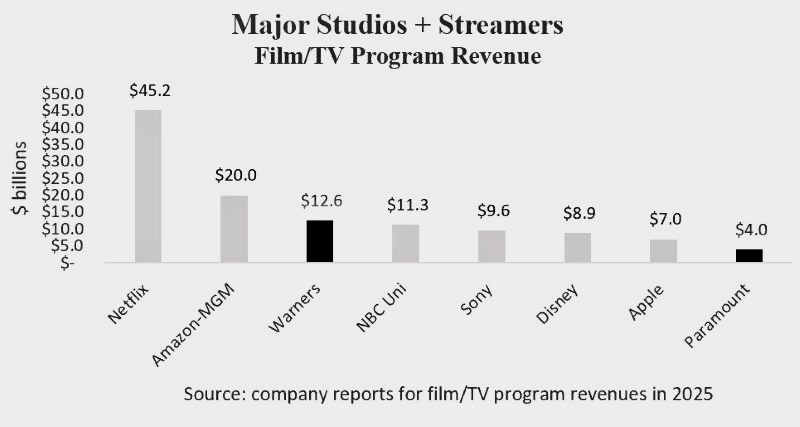
Netflix is so large at $45.2 billion in film/TV program revenue that a combined No. 3 Warner ($12.6 billion) with No. 8 Paramount ($4 billion) won’t dominate (see accompanying bar chart with Warner and Paramount in black).
Critics of the merger overlook that the movie/TV program sector isn’t just the five major studios in Hollywood anymore; three video streamers have elbowed into the film/TV program sector over the past 15 years — Netflix, Amazon-MGM and Apple TV. Heck, it can be argued having a stronger Paramount-Warner entity will create a more potent #2 to Netflix, which at the moment towers over rivals.
Combined Warner and Paramount revenue stacks up to about a third of the size of Netflix. The accompanying bar chart incorporates film/TV program revenue in 2025 from content it creates, but that’s subject to interpretation. For instance, Paramount owns CBS Television, which is a buyer of televising rights to sports (not counted).
Regulatory reviews are not supposed be an excuse for outside parties to force wish lists or reshape the business environment to their liking. And history supports the Paramount-Warner merger. In 2019, regulators approved Walt Disney Co. acquiring 20th Century Fox film/TV, in another major studio merger.

The proposed Paramount-Warner merger received 65 regulatory approvals since being announced in February. These include the notoriously difficult European Union and U.K.’s Competition and Markets Authority, which attached some conditions. That’s normal and the conditions are not onerous.
The holdup now is a lawsuit by 12 state attorney generals in the United States, who got a federal lower court judge to issue an injunction for a mini-trial next March.
While in limbo, Paramount Skydance will have to pay shareholders of Warner $650 million per quarter for delays; it’s a big penalty but is doable. If Skydance Paramount fails to acquire Warner, then Warner is eligible for a $7 billion termination fee.
Also on litigation, Hollywood labor union the Writers Guild of America separately mounted its own lawsuit to prevent the merger.

Paramount Skydance, which is led by the multi-billionaire Ellison tech family, promises to maintain the studios separately and continue cinema releases of films. It has supporters.
“When government officials manipulate markets to reach political outcomes, antitrust stops protecting competition and starts threatening it,” top Hollywood talent agent Ari Emanuel writes in an open letter to the industry. “The attorneys general should drop this case and get back to enforcing the laws as they are written.” (Emanuel is said to be the inspiration for the go-go Hollywood agent character in the old HBO TV series “Entourage.”)
A Wall Street Journal editorial supported the merger, noting “The AGs and the judge exclude film production for the much larger and growing streaming market.” So opponents narrowly focus on cinema releases of films, ignoring movies made for streaming and TV series.
There are analysis for market share using cinema boxoffice, but that’s deceptive. Streamers have typically used major studios for their films (Apple TV’s “F1” racing film comes to mind; Warner Bros. distributed theatrically). The boxoffice yardstick also ignores original streaming movies and TV programs entirely.
Reaction from cinema operators is mixed, with some supporting and some opposing.
A rational for the merger is the Streaming Age requires global scale, which means size. Video streamers cover the world and require lots of content with global reach. The old ecosystem was fragmented, with no company able to touch audiences directly globally.
Here’s an exercise in showing the different ways to evaluate the size of market for corporate mergers: If looking at manufacturers of commercial long-haul jet airplanes in transportation, then it’s just Airbus (55% market share) and Boeing (45%), or 100% together. Letting them get larger via mergers would be an obvious antitrust concern.
But … if the market is defined as all “commercial transportation,” that would also include short-haul commercial airplanes, all passenger trains, trollies, buses, taxis and even rickshaws. Airbus and Boeing account for just 15% of this more broadly defined commercial transportation manufacturing industry. So, how the “market” is defined makes a big difference in determining whether there’s a monopoly issue.
Finally, here’s an example of recent misguided merger meddling done in the name of being pro-competition. Politicians opposed the airline merger of JetBlue and Spirit Airlines, complaining it would lead to less competition. The merger was blocked, but Spirit soon folded. That resulted in less competition, meaning the meddling had the opposite effect.
Leave a Reply