
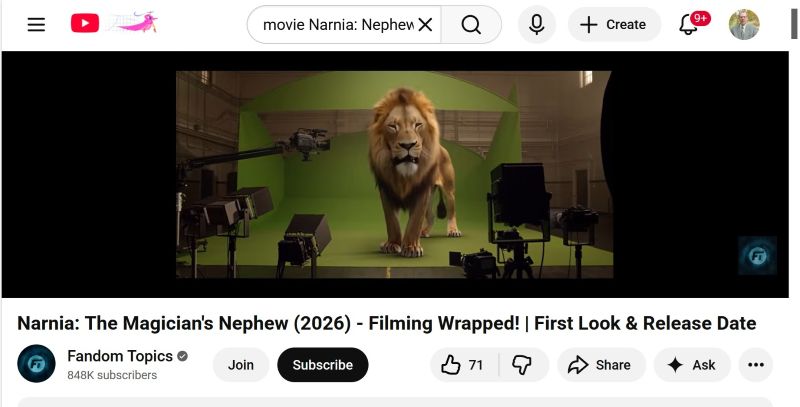
Video streamers are pumping up their theatrical slates, which is good for film supply to cinema. Amazon MGM Studios mapped out a dozen theatricals this year premiering in cinemas, in what gives it a major-studio-like profile.
Now, colossus Netflix is putting one foot forward. The largest streamer with 325 million paid subscribers globally, Netflix upgraded sci-fi fantasy “Narnia: The Magician’s Nephew” to a wide theatrical release Feb. 12, 2027. (The signature Narnia lion is pictured above in a screen grab from entertainment website Fandom Topics).
And there’s a 49-day cinema window for “Narnia” that includes big-screen Imax plays. “Narnia” then premieres on Netflix, streaming April 2.
Netflix had previously dabbled with truncated 17-day theatrical releases in a few hundred theaters for its better original films. That aimed to placate film talent wanting the prestige of cinema though many theaters wouldn’t book films with short 17-day theatrical exclusivity. Now Netflix says it embraces as a standard a 45-day window and “Narnia” is expected to premiere on 1,000+ screens domestically (U.S. and Canada).
“Narnia’s” director is four-time Oscar nominee Greta Gerwig (who helmed the “Barbie” blockbuster). Its stars include Oscar-honored Meryl Streep and (former 007) Daniel Craig. “The Magician’s Nephew” is based on acclaimed author C.S. Lewis’ 1955 novel. There have been a few “Narnia” movies over the years. News reports have suggested the production budget for the new “Narnia” at an astronomical $320 million.
“Sources say the streamer kicked about a wide theatrical release for ‘Narnia,’” reported Anthony D’Alessandro on Deadline.com. “Gerwig always wanted it. A member of the cast was injured, we hear, which delayed production for six weeks. ‘Narnia’ would not make its [original] Thanksgiving Imax date, so the decision was made to head to February 12, 2027.”
If so, “Narnia” is something of an “accidental” wide release for Netflix, but it sets a precedent, especially for Hollywood talent pressing for major cinema exposure. Netflix co-CEO Ted Sarandos, whose career is on the content side, has downplayed interest in cinema runs in the past, saying Netflix’s business is streaming.

But lately there’s a visible Netflix shift, though it’s not clear if it will be sustained and how widely into cinema. At a press event in March, Netflix Film chairman Dan Lin teased: “We’re looking to do special things in theatrical, but just give us some time.” Netflix’s animated “KPop Demon Hunters” was a surprise modest hit with $24 million in domestic boxoffice last year; that film was licensed from Sony Pictures, though is classified as a Netflix original.
Meanwhile, across the street in StreamingTown, Amazon MGM has been acting like a Hollywood major for a year with substantial cinema runs and long exclusive windows for its originals, including current cinema blockbuster “Project Hail Mary.” The sci-fi yarn has generated $318 million in domestic boxoffice and $638 million worldwide (and counting!).
Amazon MGM provides a steady flow to theaters with. Most of Amazon MGM’s other offerings, excluding “Project Hail Mary,” are mid-range performers in global cinema boxoffice. Examples are Ben Affleck and Matt Damon’s Nike shoe drama “Air” ($90 million worldwide); Affleck’s action sequel “The Accountant 2” ($103 million); sexy tennis drama “Challengers” ($96 million); and Dwayne Johnson’s holiday adventure “Red One” ($186 million). Their production budgets range from $90 million to $250 million, which is in the full range of the big-budget category.
Apple Original Films enjoyed a big cinema hit with Brad Pitt racing drama “F1,” though it has stopped short of promising a major-studio-like steady flow of theatricals. Warner Bros. Pictures distributed to theaters for Apple.
The Hollywood major studios that supply cinema films thinned to today’s five legacy players (Disney, Paramount, Sony-Columbia, Universal and Warner Bros.) when Disney bought 20th Century Fox in 2019. There were eight major studios in the 1980s.
At present, the parent of Paramount Pictures proposes to buy the parent of Warner Bros. Pictures in an $81 billion deal that is pending, but promises to maintain each major studio separately and not cut back on film releases.
A major studio distributes 12-20 wide releases a year (plus additional smaller films) and these legacy majors have dominated the movie business since the 1930s. That is the history but the future is hazy. The legacy major studios are looking a little vulnerable in the streaming age and now have company as the video streamers have elbowed their ways into the big-time movie business.
Related content:
Leave a Reply