
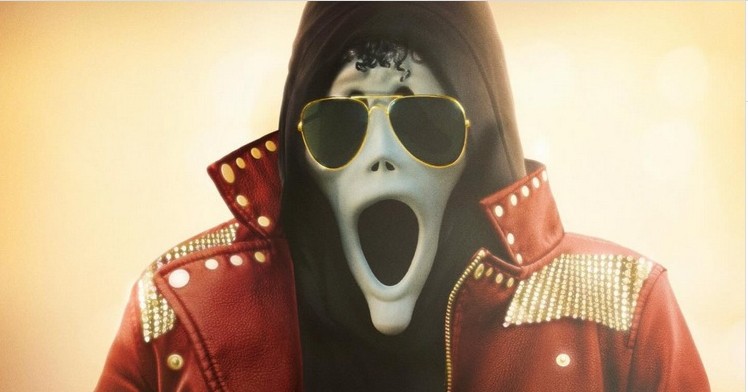
The new blockbuster Michael Jackson biography movie gets zinged by another movie with the marketing messaging that the late King of Pop is “Touching Fans Everywhere.”
Oh, dear! The satirical comedy film “Scary Movie 6” hoists an eerie image that is unmistakably Jackson (poster image above) in its advertising that incorporates the “touching” phrase. That image and verbiage irreverently reference multiple allegations that the late pop star engaged in sexual misconduct.
It’s a mocking messaging that 1) gets attention (such as right here!); 2) connects with popular culture (poking fun at “Michael” Jackson); and 3) showcases “Scary Movie 6’s” irreverent, satirical comedy.
Paramount Pictures’ comedy horror spoof “Scary Movie 6” is scheduled to premiere June 5; its teaser trailer (prior to employing the Michael Jackson zinger) garnered an astronomical 500 million views in five days. Meanwhile, the PG-13-rated music biopic “Michael” rolled up its own astronomical figure with $97 million in domestic (U.S. and Canada) boxoffice for Lionsgate its premiere weekend April 24-26. The “touching” zinger didn’t hurt “Michael’s” boxoffice, nor was that intended.
The Michael Jackson parody seems opportunistic as the final trailer a month ago didn’t reference. But then “Scary Movie 6” released a Jackson spoof trailer several days ago, when it was clear “Michael” was headed for its blockbuster premiere. Movie fans were jacked about “Michael” and the parody aimed to plug into that popular zeitgeist.
And the late King of Pop was a target before. In 2003, “Scary Movie 3” incorporated a Jackson look-alike in a trailer with that movie’s star Charlie Sheen.
Those sparse phrases incorporated in movie marketing materials are a big deal, and are carefully thought out as expressing the dominant marketing theme with a sharp point. The “key copy-line” is defined by business/academic book “Marketing to Moviegoers” as the “frequently repeated advertising slogan that summarizes the selling message for a movie.” They are sometimes called tag lines or slogans (and should not be confused with “log lines,” which are one-sentence summaries that run longer, so they don’t fit in most marketing materials).
Key copy-lines need to be suitable to incorporate in all marketing (trailers, posters, radio commercials, online, etc.) to maximize impact. To instead diffuse with multiple different messages has proven to be less effective, especially because movies live or die based on initial premiere. Movie marketing fails if it is absorbed gradually after the premiere.
Famous key copy-lines include 1979’s “Alien” with “In space, nobody can hear you scream.” In 1977, what is now called “Star Wars Episode IV: A New Hope” launched with “A long time ago in a galaxy far, far away” taken from the opening text scroll in the movie (poster image below).
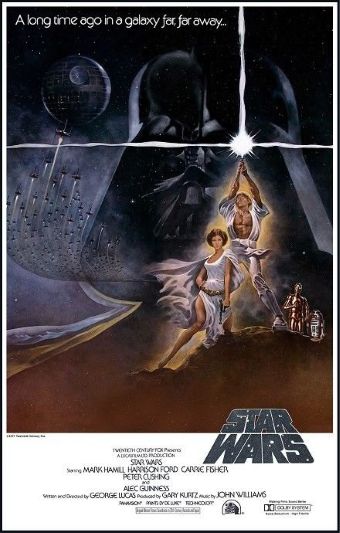
Both position the movies as sci-fi fantasies, which enables audiences to locate the genre. But these key copy-lines communicate more. “Aliens” conveys the antiseptic and lonely nature of outer-space travel, which is good because “Alien” is a horror film. For “Star Wars,” it’s implied there will be swash-buckling adventure in distant worlds. Just getting across the subtle suggestions of secondary attributes is fine marketing; moviegoers will use their own imaginations to fill in the blanks.
Great key copy-lines clearly position a movie’s genre, so the core audience can find, but suggest and imply more. Warner Bros. 2007 sci-fi “The last man standing is not alone” … okay, who else is there?
For “Jaws” in 1973, the marketing conveys unseen terror with “Just when you thought it was safe to go back in the water.”
A new “Spaceballs” comedy (set to hit cinemas next year, coming 40 years after the original) is initially using “Just like the old one. But newer,” which communicates its impish and deadpan humor, and leaves room for more messaging later as marketing unfolds.
When Frankenstein yarn “The Bride” seemed headed to a poor opening, Warner Bros. Pictures employed a marketing form of shock treatment with ““Here Comes the F*%#ing Bride!” That key copy-line is an attention grabber, but this horror film still suffered a weak premiere weekend last month.
A characteristic of key copy-lines is to force marketing to settle on a single, narrow choice. With a dozen words or less, it’s not possible to squeeze in multiple messages. Some film marketing can cram in multiple messages like in TV commercials that can incorporate several thrusts or a poster with multiple images.
Billions of dollars in marketing are spent to spray those short, punchy phrases across the mass media eco system. So, they better turn heads and be a catalyst to sell tickets and view movies. It’s proven that a single, compelling marketing message delivered with repetition is the most effective.
Related content:
Leave a Reply