

“The Running Man” is a rare example of a film suffering declining audience interest the more that its marketing campaign rolls out. Starring up-and-comer leading man Glen Powell, the dystopian drama got knocked for being too serious , which hews close to its source Stephen King novel, a dark thriller. The 1987 film adaptation with the identical title starring Arnold Schwarzenegger was a modest hit by taking a breezy and action/adventure approach.
Paramount’s new “Running Man,” which cost an estimated $110 million to make, generated a mediocre $16.5 million domestically its Nov. 14-16 premiere weekend. It launched on 3,534 screens in the U.S. and Canada; 1,000 screens is a wide release. At the same time, the first wave of its cinema runs overseas were also disappointing.
Pre-release audience tracking forecast a $20 million-25 million premiere, but then shrank. Such a tracking decline is unusual. Marketing should hold fans that are aware and then enlarge by introducing the film to those unaware.
The new movie ranked #2 for the week behind Lionsgate’s “Now You See Me; Now You Don’t” third installment at $21.0 million domestically from 3,403 screens (both were new releases). The third “Now You See Me,” which is a $90 million production, improved on its early tracking forecast, which is the normal trajectory. It was initially expected to trail “Running Man,” which it ended up besting.
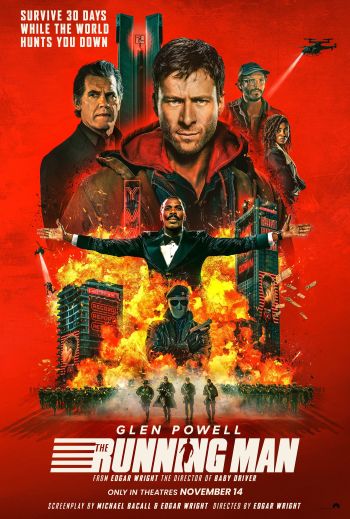
Professional film critics were generally upbeat about the new “Running Man” directed by Edgar Wright (“Baby Driver” and “Shaun of the Dead”), more so than for the Schwarzenegger-fronted screen adaptation of 1987.
“One could argue that Wright sticks too close to the source material,” wrote James Berardinelli on Reelviews.net. “At times, the film suffocates on its own seriousness. The 1987 movie was cheesy fun. This one isn’t cheesy, but it’s not a lot of fun, either.”
Interestingly, author Stephen King is known to dislike the 1987 adaptation. But the celebrated horror-story novelist is more upbeat on the new version. Both of King’s views on those films are curiously opposite cinema-audience reactions.
In creative messaging, the marketing for the new film is built on social commentary and satire, which is a tough sell to a broad audience. Secondarily, it pokes fun at the reality TV genre, but in the age of the social media influencer that seems dated.
Finally, rising Hollywood leading man Powell gets the spotlight in marketing to pull the female audience. But unfortunately, Powell is downtrodden and sweaty in the storyline, so not a chick magnet.
In contrast, the 1987 version was positioned more of an action film, given Schwarzenegger starring, which is a conventional marketing pitch.
In another obstacle, the new “Running Man’s” audience classification of R-restricted (ages 17 and younger must be accompanied by adult) limited potential compared with the “Now You See Me” competition. The latter is PG-13 (caution for ages 13 and under, but no restriction enforced).
“Running Man” also got handed off during a corporate regime change at its distributor Paramount Pictures, whose parent was sold Aug. 7 and its head of marketing replaced.
Another nagging question remains why remake the 1987 film at all, since the first was just a moderate success. The 1987 “Running Man” ranked 30th domestically in 1987, so not a massive hit or a miss. The new version will probably fall short of that ranking, but good reviews make predicting its finish difficult when the year ends.

Another recent remake of that era is “Tron: Ares” spun from the 1982 Walt Disney sci-fi release that also was only so-so, like “Running Man.” The new “Tron Ares” grossed $72.7 million domestically (U.S. and Canada) so far since Oct. 10. It’s currently ranked a ho-hum 24th in for the year in boxoffice, and destined to slip further after holiday releases pile on.
In both cases, why remake unremarkable boxoffice performers? Yes, the title/intellectual property has some brand-equity with consumers, making the films easier to market because of built-in awareness. But it’s just a general familiarity, and not any deep affinity.
Some pundits also moan that star Powell, whose chiseled youthful good looks in “Top Gun: Maverick” made him a leading man, doesn’t have the star-power to open a movie. Time will tell. Powell’s career has plenty to go, though it’s clear he doesn’t yet hold audience gravitas with “Running Man.”
Related content:
Leave a Reply