
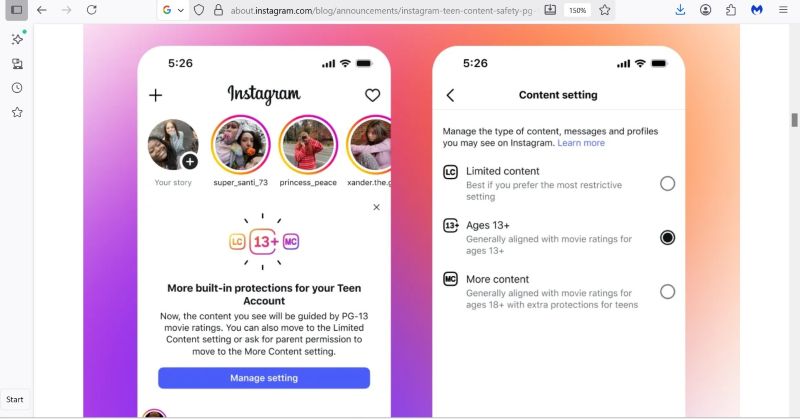
Instagram will police content for ages 18 and under using Hollywood’s PG-13-rating standard, as the website is under regulatory and legal pressure over child protection. Implementing the off-the-shelf PG-13 standard (image above), which is proven in decades of cinema use, aims to blunt complaints that Instagram makes it too easy for sex predators to connect with teens and for teens to consume age-inappropriate content.
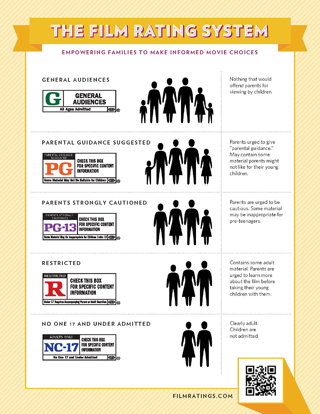
One immediate impact is that movie marketers conforming with industry self-regulation can’t market to Instagram’s ages 18-and-under audience for its movies with audience classifications of G (general audience-everyone) and PG (parental guidance suggested). Presumably G and PG films can only be marketed when younger Instagram audiences are the defined target.
The cinema PG-13 standard means parental guidance comes strongly recommended because some scattered content may not be suitable for ages 13 and under, but most is appropriate.
An Instagram post of Oct. 14 explains: “Teens under 18 will be automatically placed into an updated 13+ setting, and they won’t be able to opt out without a parent’s permission. And because we know that all families are different, we’re also introducing a new, stricter setting for parents who prefer a more restrictive experience for their teen.”
The Instagram post continues: “Just like you might see some suggestive content or hear some strong language in a PG-13 movie, teens may occasionally see something like that on Instagram — but we’re going to keep doing all we can to keep those instances as rare as possible.”
In a September update, another Instagram post said: “Teens under 16 will need their parent’s permission to use fewer protective settings. … Once supervision is established, parents can approve and deny their teens’ requests to change settings or allow teens to manage their settings themselves.”
A Hollywood Reporter story by Alex Weprin says that the Motion Picture Association, which is the trade group for Hollywood major studios and other giants that co-administrates the PG-13 audience classification, was not involved in Instagram adopting PG-13 nor was it consulted in advance.
Instagram is owned by Facebook’s parent Meta Platforms. The ready-made PG-13 standard can be expected to ease regulatory and legal pressure on Instagram that has been building in recent years.
A 2019 report by the Federal Trade Commission (FTC) titled “Inappropriate Interactions with Children on Instagram” gained attention earlier this year with its embarrassing analysis of Instagram.
“In the report, Instagram researchers found that nearly 2 million accounts operated by minors had been recommended to ‘groomers’ — a term referring to adult sickos who target kids for sexual purposes — within a single three-month period,” Thomas Barrabi wrote in May in the New York Post. Further, the FTC report says that parent Meta “starved” Instagram of funds necessary to strengthen youth protection in recent years, according to the New York Post. Parent Meta “knew Instagram was steering underage users toward online creeps and other harmful content.”
As for age verification, it’s a lot easier for cinemas, where the customer shows up in-person. Instagram says it has a multi-layered validation process that ages claimed are correct. The website says that it requests video selfies, uploading of images of identification documents, and AI analysis to check fact-points such as claimed birthdays.
Instagram may also be cleaning up its act as legacy TV outfits like cable TV networks try to claw away some online digital advertising spending, using sophisticated artificial intelligence targeting to improve effectiveness of conventional TV commercials. Having strong child protection will blunt those efforts, since most advertisers insist on a safe media environment for their commercials.
Cinema ratings, which are simply presentation of audience suitability classifications, were introduced in 1968 to blunt government from doing the same. “The film classification process in the United States is entirely voluntary” and run by industry, notes the third edition of academic/business book “Marketing to Moviegoers.” “As a result, the United States has one of the world’s few non-governmental national film rating systems.”
The PG-13 rating was adopted in 1984, after an outcry stemming from family adventure film “Indiana Jones and the Temple of Doom.” The Harrison Ford action movie was rated PG, but one over-the-top scene briefly showed a beating human heart ripped from a captive. The rest of the film did not contain objectionable material, so PG-13 became sandwiched between PG and R (restrictions for ages under 17).
LATE ADD: Trade group Motion Picture Association later says that it was not consulted by Facebook in adopting the PG-13 rating. In December, the attorney general of New Mexico assailed Facebook’s claims of youth protection as a “dangerous promotional stunt that lulls parents into a false sense of security about the risks their children face when they use Instagram.”
Related content:
Leave a Reply