
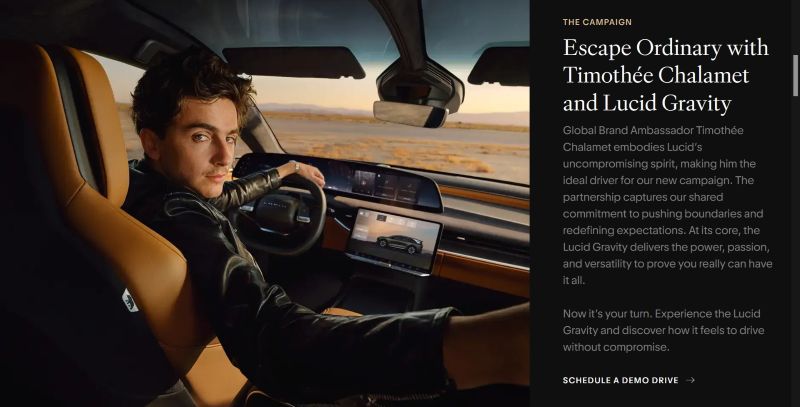
Top Hollywood film talent is increasingly comfortable endorsing products and services, evidenced most recently by Timothée Chalamet and director James Mangold shilling for Lucid electric cars.
The actor and the director/writer collaborated for hit theatrical movie “A Complete Unknown,” with both getting Oscar nominations for the Bob Dylan-biographical flick. Above, Chalamet is seen in a screen grab from a Lucid webpage.
For Lucid, Chalamet stars in a 2-minute short film directed by Mangold promoting the Gravity electric car from Lucid. The short is titled “Driven” with Chalamet’s character and his new bride behind-the-wheel of a you-know-what-brand electric vehicle.
“The new campaign for Lucid Gravity marks the beginning of the brand’s multiyear partnership [announced in July] with Chalamet, and can be experienced in 30-second, 60-second, and an extended two-minute director’s cut format,” a Lucid press release says. “As the first-ever global ambassador for the brand, Chalamet will be featured in upcoming campaigns, creative content, and more.”
The Hollywood connection extends to “the stunt team from Mangold’s 2019 ‘Ford v Ferrari’” movie working on the electric vehicle short, the Lucid PR adds.
The alliance is a type of tie-in promotion aligning the two talent’s personal brands with Lucid; no specific movie is directly involved or benefiting. Mangold’s involvement came through production company Minted Content.
Such Hollywood + consumer product alliances are a growing phenomenon, as talent leverages its personal celebrity for paydays from consumer goods marketers.
It’s unimaginable that legends like Jimmy Stewart, Kirk Douglas or John Wayne would have endorsed a cologne or car at the height of their careers, except if their studio employers arranged a movie tie-in promotion (which typically was for no-pay). But it’s a new era with a long list of top talent as pitchmen/women for consumer products unrelated to their film or TV projects.
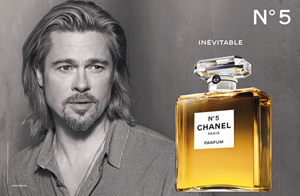
They include Brad Pitt for Chanel No. 5 cologne, Dakota Johnson for Roberto Coin jewelry, Leonardo DiCaprio for Tag Heuer wrist watches, two-time Oscar winner Adrien Brody for startup luggage brand Monos, Laurence Fishburne for Kia cars, and Nicole Kidman for fashion designer Jimmy Choo. Earlier this year, clothing retailer the Gap launched a high-end limited-quantity line of matching black-satin men’s jackets and shirts after Chalamet generated publicity wearing the combo at an Academy Awards dinner as “A Complete Unknown” nominee.
Why is this happening now?
One driver is that endorsement pay has skyrocketed. Consumer goods marketers pay hundreds of thousands of dollars to top Hollywood talent to present in marketing. Even online influencers with no Hollywood fame can pocket tens of thousands of dollars for simply appearing at corporate events. Hollywood talent agents who used to turn up their noses to forays in commercialism now actively pursue deals that fatten their commissions pay.
“Celebrities are persuasive in delivering brand messages to consumers and their images/voices are attention grabbers,” says the third edition of “Marketing to Moviegoers.” Madison Avenue consumer goods marketers have to work with talent’s representatives such as endorsement agents and lawyers who can be demanding. And talent can condition work on approvals and hiring from their entourages, such as hair stylists and fashionistas. But consumer products marketers accept the hassles figuring associating with the celebrity helps their advertising break through the media clutter by giving their brand a unique pop-culture association.
Filmdom used to have a taboo, where only past-their-prime stars jumped for endorsement paychecks. But consider in-their-prime sports and music celebrities have for years shilled for consumer marketers, so Hollywood grabbing similar pay checks is not so surprising.
A new twist is Hollywood celebrities lending their names to startups ranging from liquors such as Casamigos Tequila with George Clooney to tech outfits such as Mint Mobile with the ubiquitous Ryan Reynolds. In those and other cases, the celebrities own a piece of the companies. A few decades ago, instances where celebrities are deeply embedded in a business were rare.
As for movie “A Complete Unknown,” the R-rated film exceeded prerelease expectations with $75 million in domestic box office in its 2024 release. It received acclaim from film critics and also eight Oscar nominations including for Chalamet and Mangold (though no wins). The period drama cost moderate $60 million-70 million to make. Walt Disney Studios-owned specialty arm Searchlight distributed.
Meanwhile, Lucid is a California-based electric vehicle startup whose cars are manufactured in Arizona. The company’s stock is publicly traded although its financial position is precarious because of the capital-intensive nature of manufacturing.
Related content:
Leave a Reply